Upload time : 2026-07-25 15:46
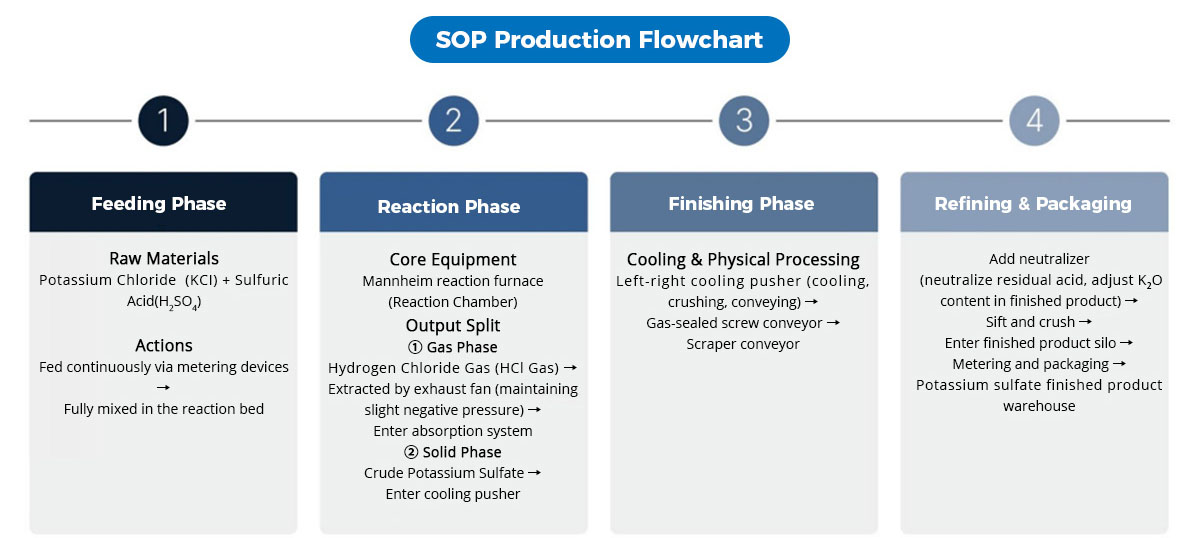
The preparation of potassium sulfate and the generation of hydrogen chloride gas are completed in the reaction chamber.
The generation reaction process is as follows: The temperature in the reaction chamber is controlled within the range of 510-560°C. With all equipment in normal operation or standby condition, potassium chloride and sulfuric acid are continuously fed into the reaction bed through metering devices at a suitable feed ratio, fully mixed, and react to generate potassium sulfate and hydrogen chloride gas. The hydrogen chloride gas is continuously extracted by the hydrogen chloride exhaust fan, maintaining a slight negative pressure in the reaction chamber. The finished potassium sulfate is continuously discharged from the reaction chamber into the left and right cooling pushers. After cooling, further crushing, and pushing, the potassium sulfate is sent to the belt conveyor via an air-sealed screw conveyor. After screening, crushing, and adding a small amount of neutralizing agent to neutralize acidity, it enters the finished product silo, is weighed and packaged, and then sent to the potassium sulfate finished product warehouse.
Cooling and Absorption of Hydrogen Chloride Gas:
(1) The hydrogen chloride gas generated in the reaction chamber has an outlet temperature as high as over 400°C and needs to be cooled by heat exchange to ≤50°C to facilitate sulfuric acid gas washing and hydrochloric acid production. This process takes place in the carbon cooler. Since the hydrogen chloride gas still contains trace amounts of dust and impurities, to prevent clogging of the carbon cooler, a mixed acid washing process is included. The washing liquid comes from the outlet of the acid washing pump and returns along the hydrogen chloride gas flow path to the flushing acid tank and sulfuric acid gas washing tower. Cooling water flows from bottom to top from the water distributor back to the return water hopper, using two-stage cooling.
(2) The hydrogen chloride gas discharged from the carbon cooler contains a small amount of sulfuric acid gas (mainly sulfur trioxide) and material particles. To produce high-quality hydrochloric acid, it is necessary to wash away the sulfur trioxide and particles. This process takes place in the flushing acid tank and sulfuric acid gas washing tower. The mixed acid absorption liquid is controlled at a certain concentration and continuously transferred to the mixed acid intermediate tank. Dilute hydrochloric acid is supplied from the tail gas recovery system. The washed hydrogen chloride gas then enters the acid production system.
(3) The washed hydrogen chloride gas and dilute hydrochloric acid from the acid production pump flow concurrently into hydrochloric acid absorption tower A to complete the falling film absorption process. Concentrated hydrochloric acid, controlled to a specific concentration, is sent to the hydrochloric acid intermediate tank. Unabsorbed hydrogen chloride gas enters hydrochloric acid absorption towers B and C, flowing concurrently with dilute acid from the tail gas washing tower to complete the falling film absorption process. Hydrogen chloride tail gas enters tail gas recovery tower (No. 1). Clean water comes from tail gas recovery tower (No. 5) and is continuously fed through a metering device with a controlled appropriate amount of water. The absorption liquid (dilute hydrochloric acid) branches from the outlet of the tail gas washing tower pump into the acid treatment tank for self-circulating absorption in the absorption towers. The acid production process uses a three-stage series device. Since the absorption of hydrogen chloride is an exothermic process, it is necessary to remove the reaction heat to facilitate the reaction. Therefore, the hydrochloric acid absorption towers are equipped with jacket cooling devices. Cooling water comes from the water distributor, flows from bottom to top to the return water hopper, and into the circulating water pool, controlling the outlet water temperature of each tower to ≤40°C.
(4) The hydrochloric acid in the hydrochloric acid intermediate tank is controlled to a certain liquid level. When the predetermined level is reached, tank switching is performed promptly. After sampling and analysis confirms the hydrochloric acid is qualified, it is sent to the hydrochloric acid storage tank using the acid transfer pump.
(5) Hydrogen chloride tail gas from the acid production system is drawn by the exhaust fan through washing towers No. 1 → No. 2 → No. 3 → No. 4 → No. 5 and discharged into the atmosphere through the chimney. The tail gas recovery system uses a five-tower series process. Hydrogen chloride gas and dilute hydrochloric acid react in counter-current contact within the packed recovery towers. The hydrogen chloride tail gas concentration gradually decreases from tower No. 1 to ... to No. 5, and the dilute hydrochloric acid concentration gradually increases from tower No. 5 to ... to No. 1, each forming a concentration gradient. Clean water is added to tower No. 5 and gradually transferred to tower No. 1. The absorption liquid from tower No. 1 is quantitatively transferred to the sulfuric acid gas washing tower. Tower No. 1 also has a liquid phase flow sent to the hydrochloric acid intermediate tank. The absorption reaction is also exothermic. Depending on the amount of hydrogen chloride absorbed, the temperature of each tower gradually decreases from tower No. 1 to ... to No. 5, also showing a temperature gradient. The absorption in each tower is at a slight positive pressure. Tail gas is discharged into the atmosphere through the chimney, ensuring that tail gas emissions meet standards before operation.
The process principle of the potassium sulfate production project is to use potassium chloride and concentrated sulfuric acid as raw materials, react them at high temperature, and through a series of process steps, produce the main product, agricultural potassium sulfate, and the by-product, industrial hydrochloric acid. According to tests by the Technical Supervision Bureau, potassium sulfate meets the first-grade product quality standard of GB20406-2017. Indicators such as potassium oxide content, chloride ion content, moisture content, and physical properties all meet or exceed those of similar foreign products. The by-product hydrochloric acid can be adjusted to produce products of various concentrations below 31% according to customer needs, with quality meeting the requirements of the by-product acid standard HG/T3783-2005.
Phone: +86 13953304590(Manager Wang)
E-mail:wangdongwei170@gamil.com
Address:Zichuan District, Zibo City, Shandong Province, China